January One -- blog book tours
October 07, 2006
Spin to Knit!
Note: Shannon was kind enough to share her day with Seraphim, my recently finished handspun handknit shawl. I've peppered the interview with pictures taken at the Getty Museum in LA where the shawl and I were generously photographed by Julia. More pictures and relevant information about this project appear after the jump. Thanks!
hellohello? Is this thing on? Hi everyone! I’d like to introduce you to Shannon Okey, esteemed author of Knitgrrl and Knitgrrl2 and the new Spin to Knit: The Knitter’s Guide to Making Yarn published by Interweave Press. Shannon’s book is sort of a how-to/pattern book with something for everyone interested in spinning.
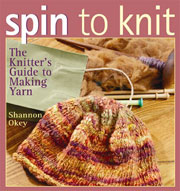
She teaches you the basics of spindle spinning, wheel spinning, drafting, and plying along side introductions to fantastic spinners, dyers, and fiber artists across the country, as well as giving you great patterns for putting your new handspun yarn to use! It’s all here!
Before we start the interview, I’m going to pull out a joke because I’m a little bit nervous about this and you’ve had some tough interviews this week and I’m not really feeling so Mike Wallace-ish . So a joke it is:
A chicken and an egg are laying in bed together. The chicken rolls over, lights a cigarette, turns to the egg and says "Well, I guess we answered that question." (I will use every opportunity to tell this joke!)
1/1: So, Shannon, which comes first, the pattern or the handspun?
SO: For me, it’s the handspun. I really, really admire someone like June Oshiro who can sit down and say “I want a yarn with this, this, this and this quality.” Then she sits down and tests and samples to gets just what she wants. I admit it: I have no patience for that. I could if I really wanted to, but I don’t want to. I just want to knit! What happens in practice is something like the Laurabelle Swedish heart shrug in the book: Kristen Welsh spun all these gorgeous little samples from the same roving, plied and drafted differently, thinking I’d just take a look at the samples and use the main yarn instead. Oh no – when you look at that pattern (you can’t tell unless you’re up close) I actually used everything she sent, samples and all. I thought “hey, it’s all from the same roving, it’ll look great” – and it did!
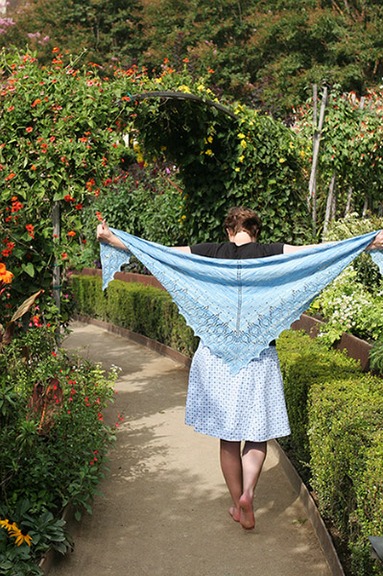 1/1: I just completed my first handspun project, the Seraphim shawl, and while I was spinning away, I knew that I would be using the yarn for a shawl. I just didn’t know which shawl. When spinning yarn that you know you want to use for a large project, how much planning do you think you have to do in advance?
SO: Good for you! I lack patience. (What, you couldn’t have figured that out by my last answer?) I can plan…but usually end up knitting before I really “should.” Maybe it’s just luck, but it always seems to work for me. I was told when I first began to spin that you should spin enough for the entire project before you start knitting, but I don’t think I’ve ever done that! There’s good reasoning behind it – if you’re working with a natural fleece or a multicolor roving, you may want to switch balls occasionally to avoid huge stripes of one color next to another, and if you’re not a super-technical spinner, you may want to balance out the slightly different weights of yarn that result.
For me, the advance planning would come in only if I know I only have X amount of the one roving I want to use – say I’m making a sweater and there’s nowhere near enough fiber, but I’ll supplement with another yarn (handspun or commercial – that’s the beautiful part about many patterns in Spin to Knit – you can mix and match handspun with stuff from the store if you like). I’d spin up the limited-amount stuff first, measure how much I have and then figure out what comes next, whether it’s buying 500 yards of yarn at the store to mix in, or spinning something else to make up the shortfall.
1/1: One of the things I love about Spin to Knit is that you have sort of a laissez-faire approach to the whole craft. If the yarn looks good, it’s a WIN! I completely agree. I can’t really be bothered with all of the technical stuff – I just want to spin pretty yarn that I can use. But what I found with my own project is that handspun doesn’t act like commercial yarn. (DUH.) I actually had to switch needle sizes halfway through the project because one skein of yarn was so different from the other skein of yarn. Do you have any suggestions for working around the peculiarities of handspun? Other than having an open mind and being flexible? 
SO: This is where Denise and other interchangeable-needle-tip needles really come in handy! That’s probably my favorite way to address that particular problem. In the case of something like a sweater, I actually think the slightly different gauges give it character – after all, if you wanted a 100% perfectly-knit sweater you probably wouldn’t even handknit it, you’d go to the store! But with something more delicate like a lace shawl, you don’t want some big slub in the middle of a pattern repeat, right? In that case, I’d probably rip out the slubby section and go to the next “good” section. You’re right: open mind + flexibility = success.
1/1: Another one of my favorite parts of the book are your interviews with fiber artists from all over the place. They all have great stories to tell and I love the tips! I can’t wait to try Angela Ho’s spice shaker cap plying template (p. 71) where she suggests using a cap with holes to keep the various singles in order when plying. Any other fantastic tips that didn’t make it into the book?
SO: More than you could imagine. I’d tell you, but then what would I put in Spin to Knit 2? (Which doesn’t actually exist yet, but might if enough of you buy this one. Wait – was that a little too obvious?)
1/1: The absolute BEST part of the book for me? The pre-drafting section. Hands down. GREAT pictures of what the fiber looks like before during and after pre-drafting. Excellent. When I was first learning to spin, pre-drafting was what made everything click for me. I don’t remember where I first learned about it ( it wasn’t in any of the books I had at the time) but it was ESSENTIAL to learning how to spin and it wasn’t talked about enough. Not really a question, I guess, but I just wanted to say thanks for that section. Nicely done.
SO: Say thanks to my mom, the photographer. She’s the one who had to resist the urge to run off and play with the dog during the photoshoot. I’ll send her your regards…
1/1: What is your favorite handspun project EVER? And what’s your favorite handspun yarn EVER? Do you have any fiber preferences when it comes to spinning?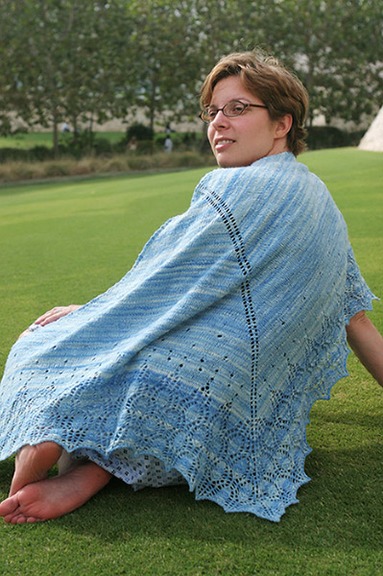
SO: Oooooooh, you’re going to make me decide among my children? Come on, Solomon, that’s unfair. Ok, if you had me up against a firing-squad wall, I’d say the hat on the cover, because it’s made of the very first roving I ever dyed, and I just love it. Sentimental value + awesome colors. As for favorite handspun yarn ever, I am very very partial to the one that got away – lesson learned, if you see something online you like, buy it immediately because when it’s gone, it’s gone. It was shades of purple plied with a yellow plying thread, which made it look like irises. I wouldn’t have even knitted it, I just would’ve wanted to stare at it all day.
Fiber-wise, I’m all about the wool… or wool with a little something extra blended in, like tencel (which dyes a slightly different shade than the surrounding fiber, and makes a cool effect when you spin it).
1/1: What attracted you to spinning? I know for me, it was all about color. I wanted to make gorgeous barber pole yarns. I didn’t really care about that whole sheep to shawl thing. What about you? Ready to raise some sheep?
SO: Oh yes. Color, please, yesthankyouma’am. I do want sheep, but my ever-patient and loving boyfriend says no, you live in the city. (So I’m working on that. Anyone got land in southern Maine they want to sell? We’ll move in a heartbeat).
1/1: Last Spring I sort of organized this event, which I called Spin Out. It was a lot of fun and we managed to raise a little bit of cash and turn on some new spinners. I’m thinking of doing it again next year – want to come and play with us? I promise it will be fun. SAY YES!
SO: How could I say no to an emphatic request like that? Of course!
Thank you Shannon for providing a new resource for spinners! One that’s accessible on all levels, beautifully crafted and chock full of fibery goodness. Good luck with the book and the rest of your tour. I’m sure you’re in GREAT hands with Lolly on Monday. Although if she starts talking about socks, I say RUN. ;-)
Keep reading for pictures and info on my handspun shawl....

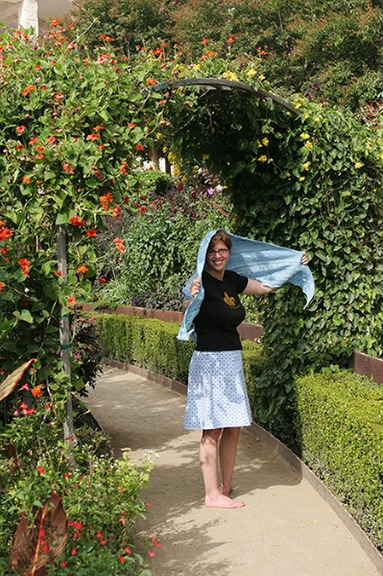
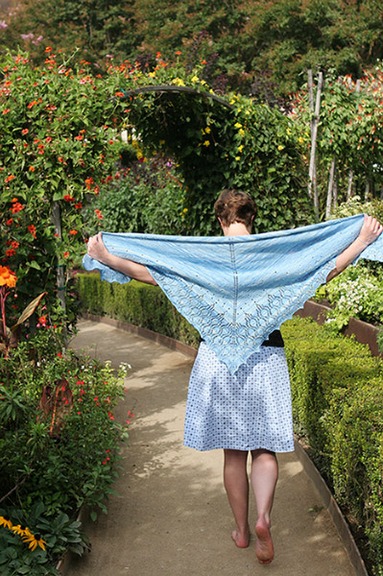
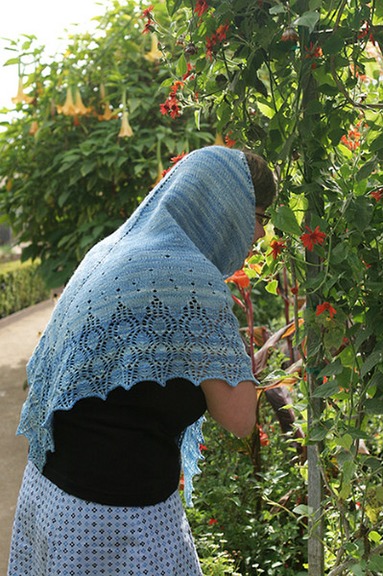
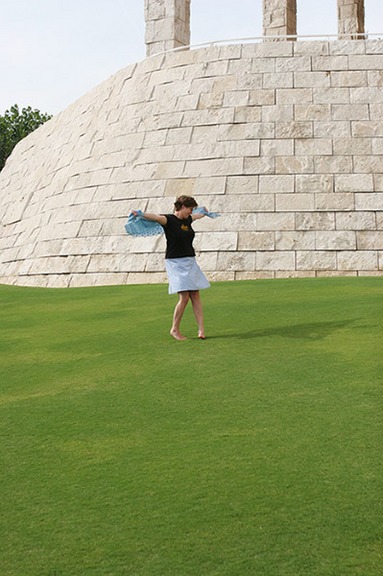
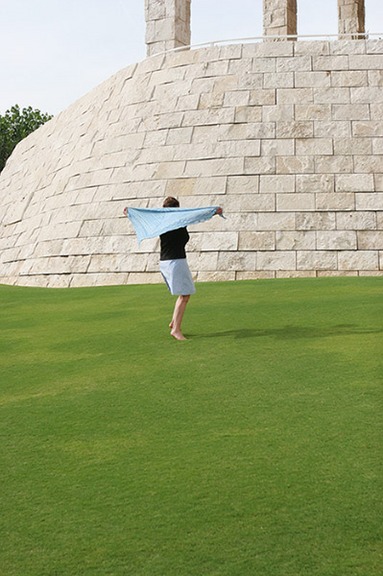
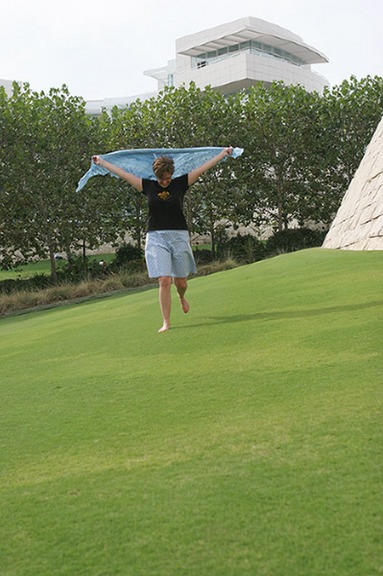
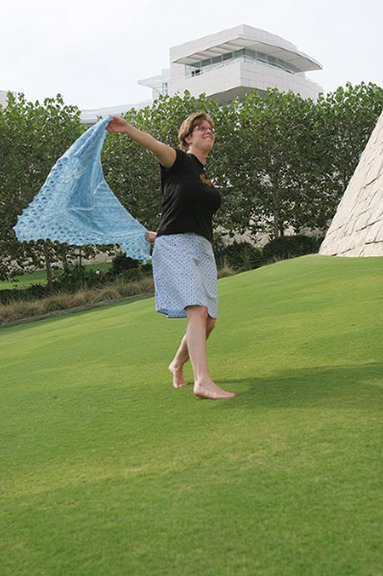
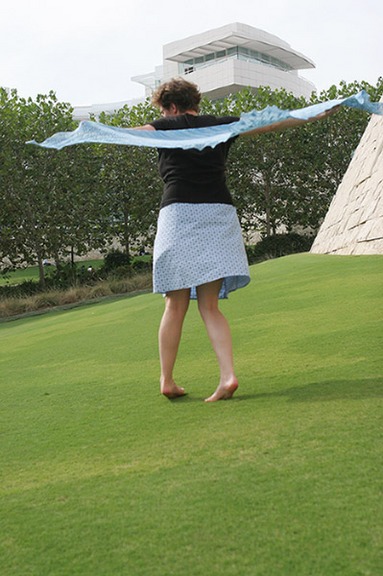
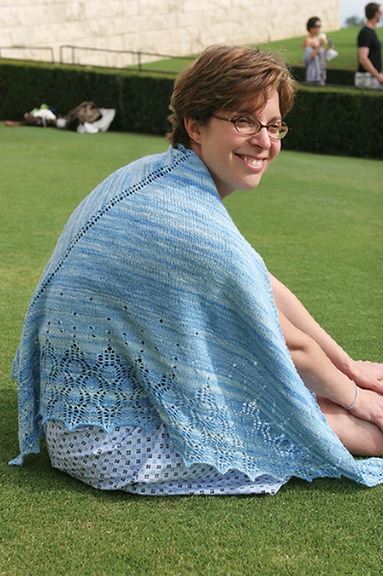
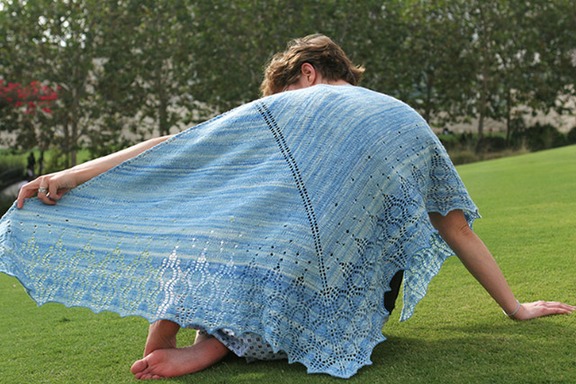
MY FIRST HANDSPUN HANDKNIT!
Pattern: Seraphim by MimKnits
Yarn: MY OWN! With a help from a fantastic dyer. The fiber came from Amy Boogie at Spunky Eclectic. It's Merino in the Almost Solid Series, Moon Flower colorway. Amy has the BEST FIBER EVER! I could spin only her fiber for the rest of my life and I would be happy. This yarn is two-ply and I estimate it to be about fingering-sport weight. I spun up 8oz which came to about 850 yds and used all but about a yard of yarn. For a minute I was afraid I was going to run out, but then I found the sample mini-skein I had made and it was all good.
Needles: I used Addi Turbos #6s for the mainly stockinette section and #7s for the lace section because of variations in the yarn.
Photography:All photographs were taken by Julia at the Getty in LA. Thank you Julia! I love the pictures!!! (For some behind the scenes photos of our day at the Getty, check out MJ's post about our day. I had a FANTASTIC afternoon with my fave LA ladies!)
Okay - so I'm THRILLED with this shawl. I LOVE LOVE LOVE LOVE LOVE IT! It's everything I hoped my first handspun project would be. Seriously. I should just stop right now because it can't get any better than this. The yarn turned out perfect for this project and honestly the yarn turned out better than I ever could've hoped. PERIOD. Amy's fiber is a JOY to spin and the yarn is soft and squishy and blocked perfectly. The Seraphim pattern is very nice - easy enough for a beginner for sure. There are a couple of things about the pattern that bugged me. At one point I was POSITIVE there was a mistake (I even emailed Mim about it) because I seemed to be one stitch over at the end of a section - even though everything had worked out perfectly between the stitch markers I used (and the designer encouraged using.) Turns out, when you're doing a double decrease that butts up against a stitch marker, you need to borrow from the next section and move the marker over one. I didn't realize this. Ends up I inadvertently added an extra stitch at the BEGINNING of the previous row, not at the end of the section where I thought. Had a note been included about moving markers, I would've known right away that there was a problem. I think Mim is going to include this in the pattern going forward. I ended up ripping out a couple of rows, fixing the problem and knitting on from there. No harm no foul. I wouldn't generally mention this, but I think this IS a GREAT pattern for beginning lace knitters and since the pattern encourages knitters to use stitch markers (it has notations for markers in the charts) I think it's an important piece of information. I racked my brain for an afternoon trying to figure out where I went wrong because the number of stitches between stitch markers was working out fine. As I said, not a big deal, just something to look out for when you're knitting lace.
If you'd like more information about the yarn I used, you can check it out here and here and here.
Thanks, as always, for reading! And thanks again to Julia and MJ!
Have a great weekend!
L, C
Posted by Cara at 12:16 AM | Comments (41)